Final Fantasy Tactics on PS1 remains one of the most influential turn-based strategy RPGs ever created. Since its North American release in January 1998, the game has captivated millions with its intricate job system, punishing difficulty spikes, and a story that went darker than most Final Fantasy titles dared. Whether you’re revisiting Ivalice for the hundredth time or diving in for the first time, understanding the mechanics, character synergies, and battle strategies isn’t just helpful, it’s essential for avoiding a total party kill. This guide covers everything from optimal party builds to hidden jobs and side content that most players miss their first playthrough.
Table of Contents
ToggleKey Takeaways
- Final Fantasy Tactics PS1 revolutionized tactical RPGs by introducing a flexible job system that lets characters learn abilities from any class, setting a standard that influenced games like XCOM and Fire Emblem decades later.
- The game’s strategic depth comes from positioning units on isometric grids, exploiting elevation advantages, and managing ability points—making tactical positioning as important as unit composition.
- Difficulty spikes are intentional design: late-game battles like the Wiegraf fight and Elmdore encounter require specific job builds, crowd control tactics, and priority targeting rather than grinding stats.
- Final Fantasy Tactics features substantial hidden content including recruitable characters like Reis, secret jobs like the Arithmetician, and the Deep Dungeon—rewarding exploration and optional battles with powerful endgame abilities.
- The narrative in Final Fantasy Tactics stands apart by embracing tragedy and moral complexity, following Ramza through a darker story than typical Final Fantasy games, where betrayal and corruption define character arcs rather than heroic redemption.
- Modern ports on Switch, mobile, and PSP (The War of the Lions) have introduced new generations to a game that remains mechanically unmatched in strategic depth, proving that FFT’s core design transcends its 1998 release date.
What Makes Final Fantasy Tactics a Legendary Turn-Based RPG
Final Fantasy Tactics stands apart from its numbered predecessors for one fundamental reason: it’s a tactical RPG, not a traditional JRPG. Instead of standing in a line trading blows, you position units on an isometric grid, manipulate elevation, exploit terrain, and chain abilities together for devastating combo damage. The PS1 original set the standard that tactical RPGs still follow decades later.
The game’s job system was revolutionary. Unlike most RPGs that lock characters into fixed roles, FFT lets you mix and match abilities from any class you’ve leveled. A Knight can learn healing magic from the Priest job. A Thief can grab summons from the Summoner. A Wizard can equip a massive sword and go full Spellblade. This flexibility made theorycrafting part of the core experience.
Critical reception at launch was overwhelmingly positive. According to aggregated reviews on Metacritic, FFT received acclaim for its strategic depth and storytelling. The game wasn’t afraid to challenge players, either, battles could spike in difficulty hard, punishing careless positioning or poor job selections. That unforgiving design became part of its identity.
What really locked FFT into legendary status was the narrative. Set against a backdrop of religious conflict, class warfare, and personal betrayal in the kingdom of Ivalice, the story follows Ramza Beoulve through a harrowing journey where nearly every major character meets a grim fate. It wasn’t the triumphant fantasy most gamers expected in 1998.
Game Overview and Story
Setting and Plot Summary
The War of the Lions is tearing Ivalice apart. Noble houses clash, the Church of Glabados pulls strings from the shadows, and ordinary people suffer in the crossfire. You play as Ramza Beoulve, a mid-ranked knight who starts out as a squire on a rainy battlefield. He’s not a chosen one or a legendary hero, he’s a teenager watching his older brother get betrayed and left for dead.
The story spirals from there into increasingly darker territory. Ramza discovers that his family’s honor is being used as a pawn, his best friend turns into an enemy through manipulation and trauma, and entities far beyond politics, demons, ancient evils, are influencing events from the shadows. The game refuses easy answers or redemptive arcs for most of its cast.
Rivalice belongs to the same world as other Final Fantasy entries, though this tactical perspective shows you the gritty underside of that universe. If you’ve explored other Final Fantasy classics, the lore and world-building will feel interconnected, though FFT tells its own complete story.
Key Characters and Their Roles
Ramza Beoulve is your protagonist, but he’s not inherently special in any mystical sense. His strength comes from his adaptability, he can become any job and learn any ability, making him the most flexible unit on the battlefield.
Delita Heiral starts as Ramza’s best friend and squad mate. His story arc is one of the game’s most painful elements as he gets corrupted through circumstance, choice, and betrayal. By the endgame, he’s unrecognizable from the loyal soldier you first met.
Alma Beoulve, Ramza’s sister, gets kidnapped, imprisoned, and becomes the anchor for much of the tragedy that follows. Her fate is one of the few loose threads that the story never cleanly resolves.
Ovelia Atkascha is a princess caught between her own agency and the machinations of powerful forces. Her relationship with Ramza and Delita defines much of the emotional core of the narrative.
Mustadio Bunansa joins your party as a gunner and serves as comic relief early on, but his story reveals deeper conspiracies tied to ancient tech and forbidden knowledge.
Recruitable side characters like Agrias Oaks (Holy Knight), Beowulf (Dragoon), and Reis (Rune Knight) add depth through their personal quests and unique ability sets.
Core Gameplay Mechanics and Combat System
Job System and Class Customization
FFT’s job system is where the game’s strategic identity lives. You have primary jobs (the class your unit is actively leveling) and secondary jobs (which provide bonus abilities and stats). A unit equipped as a Knight can pull support abilities from the Priest job while using offensive spells from the Wizard slot. This flexibility is the secret to building unstoppable teams.
There are 20+ jobs total, split into basic and advanced classes. Early-game jobs like Knight, Archer, White Mage, and Black Mage are straightforward. Advanced jobs like Paladin (tanky support), Dragoon (high-mobility damage), Monk (raw physical DPS), and Samurai (critical-hit focused) require unlocking by meeting specific ability prerequisites.
Each job has a “Support Ability” slot, you equip abilities like Equip Axe (lets you use axes even though your job normally forbidding them), Regenerator (healing per turn), or Lifefont (drain enemy HP). There’s also a “Reaction Ability” slot for auto-triggered effects like counterattacks or spell reflection, and a “Movement Ability” slot for jump height and terrain interaction.
The spreadsheet-level depth here is intentional. You’re not just picking the “best” job, you’re crafting synergies.
Turn-Based Strategy and Battlefield Tactics
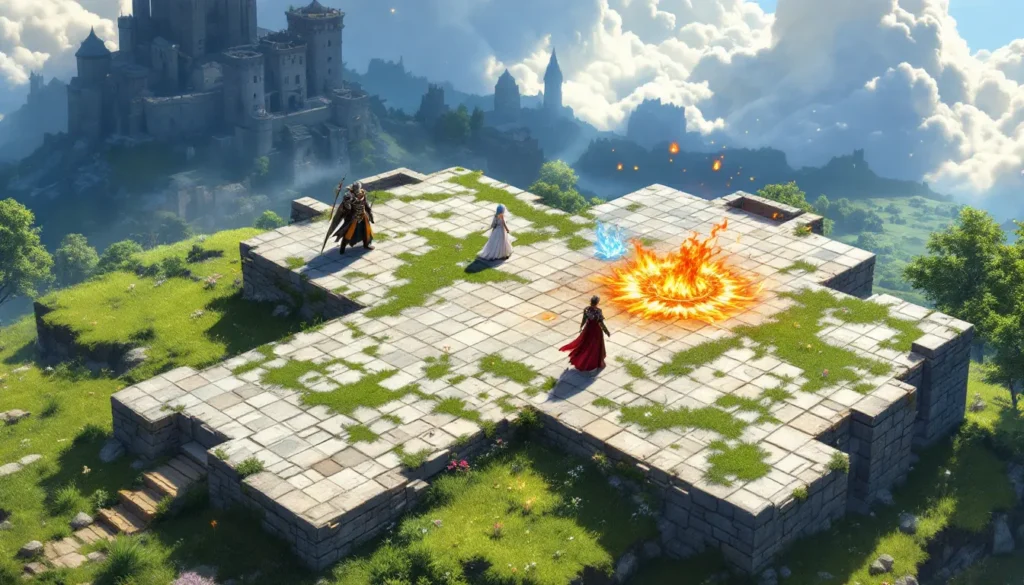
Combat happens on isometric grids ranging from small arenas to sprawling battlefields. Turn order is determined by Speed stats: higher Speed units literally go sooner. Every action (attack, spell cast, ability use, item toss, movement) costs one turn.
Elevation matters enormously. Attack from higher ground and you get bonus damage: attack uphill and your damage is reduced. Archers and Dragoons leverage height advantage hard. Monks who ignore elevation differences become mobile nightmares. Understanding how to position your units vertically, not just horizontally, separates casual players from strategists.
Ability range varies wildly. A basic sword swing has range 1 (adjacent tiles). A Black Mage casting Firaga might hit a 3×3 area from 5 tiles away. Dragoons jumping can cover half the map in one turn. Placing mages in positions where they can nuke clusters of enemies without getting surrounded is core to winning battles.
You’ll also manage Action Points (AP). Many special abilities cost AP to execute: if you’re out of AP, you’re limited to basic attacks. Resource management, knowing when to spend big and when to conserve, is as important as unit positioning.
Ability Acquisition and Skill Trees
Abilities come from two sources: job abilities (which you unlock by accumulating Ability Points (AP) during combat) and special abilities that specific character classes start with or gain through story progression.
Each job has its own ability tree. A White Mage learns Cure (single-target heal), Curaga (AOE heal), Protect (damage reduction buff), and Raise (revive). To learn Raise, you first need 200 AP in the White Mage job plus the prerequisites. This gates the strongest abilities behind commitment, you can’t grab everything immediately.
Critical jobs to level early include Chemist (access to item-based healing and stat buffs), Time Mage (haste, slow, and crowd control), and Calculator (broken AI-controlled spellcaster that can destroy entire battles if given the chance). Late-game, you’ll farm Dragoon abilities for mobility, Dancer abilities for multi-hit chains, and Samurai abilities for pure damage output.
The progression isn’t linear. You can soft-lock yourself into bad party compositions by leveling the wrong jobs too much, but the game rarely forces you into unwinnable situations, instead, a sub-optimal party just makes late-game battles grueling.
Essential Tips and Strategies for Success
Building Optimal Party Compositions
Your core four-unit party should have clear roles:
- Primary Damage Dealer: A Dragoon, Samurai, or Monk with high physical damage output and mobility. You need someone who can close distance and delete enemy priority targets fast.
- Magic DPS: A Black Mage or Time Mage for AOE crowd control and burst damage. Single-target magic is almost never worth the casting time: stick to area spells that hit multiple enemies.
- Healer/Support: A White Mage or Priest with Raise, Cure variants, and Protect/Shell buffs. You cannot win late-game battles without reliable healing and resurrection.
- Flex Slot: A Dragoon, Chemist, Ninja, or Calculator depending on the fight. This unit adapts to specific battle needs.
A meta-defining composition for mid-game includes a Paladin (tanky support knight), a Dragoon (mobile physical DPS), a Time Mage (crowd control through haste/slow), and a White Mage (healing). This setup gives you durability, damage, control, and sustain.
Don’t neglect secondary job abilities. Your Dragoon should grab Equip Sword and Equip Shield from the Knight job for better gear compatibility. Your healer should pull Chemist abilities for item-based healing backups when your MP pool gets low.
Leveling and Equipment Management
Ability Points (AP) are your leveling currency. Fighting battles with a unit equipped in a job grants AP to that job. Once you hit certain AP thresholds, new abilities unlock. There’s no experience point grind in the traditional sense, you level by fighting, and you specialize by choosing which jobs to equip during fights.
Here’s the efficient approach: Early game (chapters 1-2), spread leveling across 3-4 key jobs per unit to grab foundational abilities. Once you hit Priest (for Raise), Dragoon (for mobility), and Black Mage (for AOE damage), you have the core toolkit. Mid-game (chapters 3-4), focus jobs down one at a time to max out their ability trees. Late-game (chapters 4-5), cherry-pick the most powerful abilities from multiple jobs and stop worrying about completion.
Equipment scaling is straightforward: better gear = higher stats. Weapon shopping happens at shops in different regions. Story bosses drop rare equipment. Steal from enemies using Thieves or Ninjas to grab gear before it’s available for purchase. Equip slots follow job restrictions, Knights can equip axes and swords, but Monks are locked to fist weapons unless you grab the Equip Axe ability.
One critical resource: Gil (currency). It’s limited early on. Don’t overspend on equipment that becomes obsolete in a chapter. Prioritize healing items, revive items, and stat-buffing consumables from the Chemist shop over armor upgrades.
Navigating the Most Challenging Battles
Battle difficulty spikes hard. One moment you’re handling random encounters easily: the next, a story battle with enemy AI reading your positioning and exploiting your weaknesses sends you to the game over screen.
The notorious difficulty jumps include:
- Chapter 2 mid-point (Wiegraf fight at the windmill): A one-on-one duel against a knight who hits like a truck. This is where many casual players hit a wall. Solution: Grab as much Protect buff coverage as possible, equip heavy armor, and focus on slowly wearing him down while keeping yourself healed.
- Chapter 3 (Elmdore and his crew): Multiple casters with crowd control that can paralyze or confuse your entire party in one turn. Solution: Bring a Time Mage with Raise and focus on immediate AOE damage to thin the enemy team before they chain-cast confusion.
- Chapter 4 endgame (Delita and his forces): Enemy compositions that specifically counter your strategy. Solution: Adjust your party entirely, if you get wrecked by casters, bring more physical resistances and silence protection.
General tactics that carry you through hard battles:
- Elevation control: Position ranged units high, melees low. Enemies hate uphill shots.
- AOE spam: Black Mages casting Blizzaga and Firaga in overlapping circles delete enemy formations faster than single-target damage.
- Crowd control first: A battle where half the enemy team is slowed, frozen, or confused is a battle you’ve already won.
- Prioritize enemy casters: If a Black Mage is alive, your party takes catastrophic damage. Dragoons should ignore regular mooks and jump straight at the caster.
- Manage revive resources: Raise spells are limited by MP. If you’re burning through revives, you’re losing.
For particularly brutal fights, abuse the Chemist job. Healing items don’t consume MP, and items scale with user stats instead of equipment. A Chemist spamming Elixir and Phoenix Down can carry a struggling party through otherwise impossible battles.
Quest Guide and Side Content
Optional Battles and Recruitable Characters
FFT hides substantial content outside the main story. Optional battles unlock recruitable units with unique abilities you can’t get elsewhere, plus items and rewards that make the endgame easier.
The Deep Dungeon (accessible after chapter 4) is a 10-floor gauntlet where every floor is a battle against randomly-generated enemy formations. Beating it grants you access to Reis, a unique Holy Knight with caster abilities. She’s one of the strongest recruitable units.
Beowulf joins through a side chain tied to his personal story, finding him grants a Dragoon with unique summon abilities. Cloud Strife (yes, that Cloud) appears in a secret battle with specific recruitment requirements that involve beating a hidden super-boss.
Side battles also reward you with rare items: Excalibur (the broken holy sword), Ultima Blade (endgame Samurai weapon), and various robes that boost magic damage. These aren’t essential for winning, the story is completable with basic equipment, but they trivialize late-game battles.
To recruit characters efficiently:
- Accept all optional battles when they trigger in menus.
- Talk to all NPCs in town after each chapter: they often hint at where to find secret battles.
- Revisit old maps where you fought story battles: optional enemies sometimes appear there between chapters.
Secret Jobs and Unlockables
There are hidden jobs that redefine your build options. The most famous:
Ramza’s Squire Job: Ramza starts as a Squire and can’t change jobs initially. After chapter 1, he unlocks the Ramza-specific Squire abilities, powerful skills that scale with his stats. Late-game Squire Ramza with maxed-out abilities becomes viable as a primary damage dealer.
Onion Knight: The ultimate balanced job. It requires unlocking a secret battle and meeting specific criteria (beating all Dragoon abilities, all Chemist abilities, etc.). An Onion Knight can equip any weapon and armor, making it the most flexible endgame job.
Arithmetician (also called Calculator): One of the most broken jobs in the game. It casts random spells from the game’s entire spell pool in areas you designate. A properly geared Arithmetician can mathematically destroy entire enemy formations in a single turn. To unlock it, you need the right secondary job prerequisites and specific AP thresholds.
Mime: Copies the last ability an adjacent unit used. A Mime standing next to a Black Mage can copy every spell they cast, effectively doubling your magic output. Unlocking requires meeting strict ability prerequisites.
Finding these jobs requires:
- Maximizing multiple job ability trees (200-400+ AP per job).
- Meeting specific in-battle requirements (landing critical hits, using abilities in specific combinations).
- Revisiting late-chapter areas after story progression opens new tiles.
The ultimate endgame team typically revolves around stacking Arithmetician mages with maximum spell coverage, Mimes to copy broken abilities, and support units keeping everyone alive. It’s the opposite of a balanced team, it’s min-maxing optimized for pure power.
Multiplayer Mode and Versus Gameplay
FFT’s multiplayer was built around competitive versus battles, a feature most PS1 RPGs didn’t bother with. Two players build teams offline and compete in arena matches across four different rules sets.
Free Battle is pure composition testing, you pick any units you want with any jobs and abilities, and you fight. No restrictions. This is where endgame theorycrafting happened in 1998 before the internet made meta-building a shared conversation.
Ranked Mode (in later versions like The War of the Lions) restricted unit levels and abilities, creating a more balanced competitive environment. You couldn’t just grind one character to level 99 and dominate: everyone was on equal footing.
The multiplayer format was popular enough in the Japanese FFT community that entire tournaments formed around it. Japanese arcade versions even had online leaderboards, though that functionality never reached Western PS1 copies in real-time.
For players revisiting FFT in 2026, the PS1 version’s multiplayer is local-only (split-screen). If you want modern online play, you’re looking at the PSP’s The War of the Lions (released 2007) or the mobile ports that added online matchmaking decades later.
Tactically, multiplayer mirrors campaign battles: positioning wins fights, AOE spam is dangerous, Dragoons and Arithmeticians are overpowered, and a single good crowd-control turn can swing a match. The meta evolved around Arithmetician + Mime stacks since they’re mechanically broken in structured matches too.
Legacy and Impact on the Final Fantasy Series
Final Fantasy Tactics didn’t just succeed, it spawned a franchise. The Tactics sub-series includes Tactics Ogre (a separate tactical RPG line by the same designers), Final Fantasy Tactics Advance (2003, Game Boy Advance), Final Fantasy Tactics A2 (2007, DS), and Tactics Ogre: Let Us Cling Together remakes on modern platforms.
The original PS1 game was localized and ported multiple times: PlayStation Network (digital), PSP as The War of the Lions (2007, which added new jobs and balance changes), iOS, Android, and eventually Nintendo Switch. Each port introduced minor tweaks, new story scenes, and UI improvements, but the core game remained largely faithful to the 1998 original.
Impact on game design extends beyond Final Fantasy. Tactical RPG developers studied FFT’s job system, ability acquisition, and difficulty curve. Games like XCOM, Fire Emblem, and Divinity: Original Sin wouldn’t exist in their current forms without FFT proving that strategy-first gameplay could sustain an entire genre.
Within Final Fantasy itself, FFT’s story-telling approach influenced the series’ willingness to go darker and more complex narratively. Games like Final Fantasy 14 inherited Ivalice as part of its lore: the Tactics Crossover Raid brings actual FFT characters and mechanics into the MMORPG. Final Fantasy 12 also takes place in Ivalice and references events from Tactics, cementing the world-building as central to modern Final Fantasy mythology.
Critically, the game remains respected. Japanese gaming outlets and sites like Siliconera regularly rank FFT in “best PS1 games” and “best JRPGs ever made” lists. Its 92 Metascore (based on aggregated critical reviews) holds strong even against modern releases. The game’s influence on roguelike design, tactics games, and character-driven narratives cannot be overstated. Indie developers cite FFT as a foundational inspiration for their tactical projects.
The tactical sub-genre that FFT pioneered is more alive in 2026 than it was in 1998. Remasters of the original for modern consoles continue selling well. Players discovered through ports on Switch and mobile devices seek out other Final Fantasy classics and want more strategy-focused experiences. FFT didn’t just create a legacy, it created an entire gaming ecosystem that thrives three decades later.
Conclusion
Final Fantasy Tactics PS1 remains a masterclass in tactical game design, character depth, and narrative risk-taking. Its job system proved that player agency and flexibility trump predetermined class locks. Its difficulty taught designers that challenge and fairness aren’t mutually exclusive. Its story demonstrated that a fantasy RPG could be tragic, morally complex, and unforgettable without needing a “chosen one” hero.
Whether you’re speedrunning it on emulator, revisiting it on Switch in 2026, or discovering it for the first time through a port, the core experience hasn’t aged. Yes, the visuals are pre-rendered backgrounds and low-polygon models, a far cry from modern AAA production. Yes, some ability balance is broken in ways that make endgame trivial if you know the exploits. But the strategic depth, the party-building sandbox, and the emotional weight of Ramza’s journey transcend the hardware limitations that defined 1998.
The meta has been solved a thousand times over by speedrunners, competitive players, and theorycrafters. But that’s also FFT’s greatest strength: there’s always a new synergy to discover, a new party composition to test, a new way to break the game within its own systems. That’s why it still matters. That’s why you should play it.